



Our newest qualitative survey shows how global consumers are changing their daily routines and behaviors to be more sustainable
Analysis
As they grapple with the fallout of the global pandemic and the ongoing war in Ukraine, consumers remain mindful of sustainability. We set out to discover what’s motivating sustainable behaviors and what types of behaviors are being prioritized.
According to our survey, 46% of consumers somewhat agree and 38% strongly agree their consumption habits impact climate change, though 93.5% believe brands and governments should bear responsibility for sustainability practices. Amazon and Target have announced ambitious energy targets, aiming to be net-zero (using less energy than they produce) by 2040. Focusing on store design, both US retailers are using CO2-based refrigeration, while Target will focus on solar energy and Amazon will implement low-carbon concrete flooring.
While these initiatives are important, our survey results show people are seeking more tangible solutions, like retailers that sell products with less packaging and help with end-of-life processes and repair. As the globe gets closer to climate-crisis tipping points, governments, brands and institutions need to adapt to a more conscientious consumer. This report outlines consumer attitudes and behaviours, and strategies for engagement.
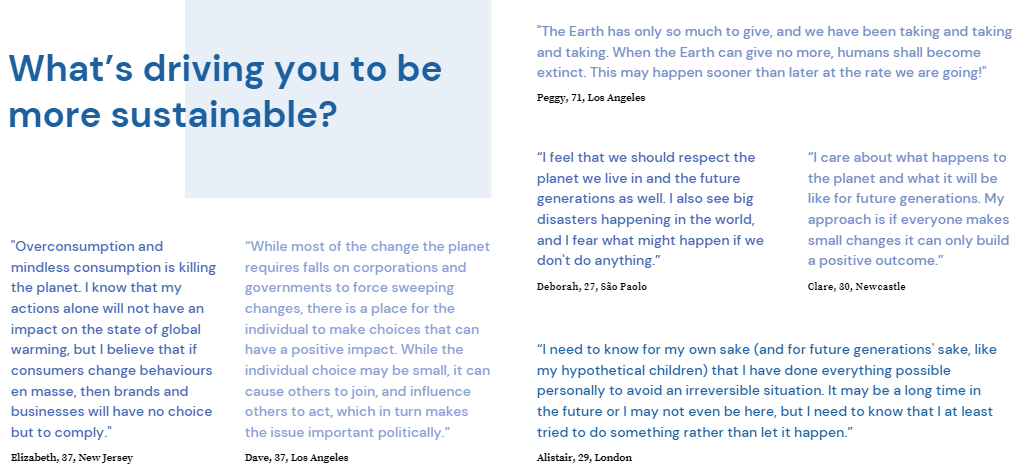
Drivers

- Combatting eco-anxiety. The emotional and mental load of the climate crisis is weighing heavy in the minds of consumers, as eco-anxiety enters the mainstream lexicon.
- Recessionary mindset. Almost 20% of our respondents say sustainable products can often be more expensive than conventional ones, but with rising fuel prices and inflation, sustainable lifestyles are quickly becoming more necessary.
- Governmental and brand support. 52.5% of our respondents said they think brands and governments should bear the responsibility for sustainability practices and they’re demanding resources to live more sustainably.
- Package-free priorities. Out of all of the efforts consumers have made to reduce their environmental impact, the move away from single-use plastic and packaging was the most adopted.
- Veganism lifestyles. Years after the reducetarian movement, consumers are continuing to cut down their animal product consumption and adopt more plant-forward diets.
- Keeping it local. 64% of our respondents said they have bought more locally since the onset of the pandemic as a means to support their community.

FULL REPORT:
 Cargando…

 Recargar el documento
  Abrir en una nueva pestaña
